EditVerse3D: High-Quality 3D Object Editing
with Region-Aware Learning

ECCV 2026

Youtan Yin1,2, Yanning Zhou2, Jiacheng Wei1, Xiaofeng Yang1, Jun Zhang2,
Jiayang Bai2, Jingwen Ye2, Weidong Zhang2, Guosheng Lin1
1College of Computing and Data Science, Nanyang Technological University
2Tencent AIPD
Work done during an internship at Tencent AIPD.
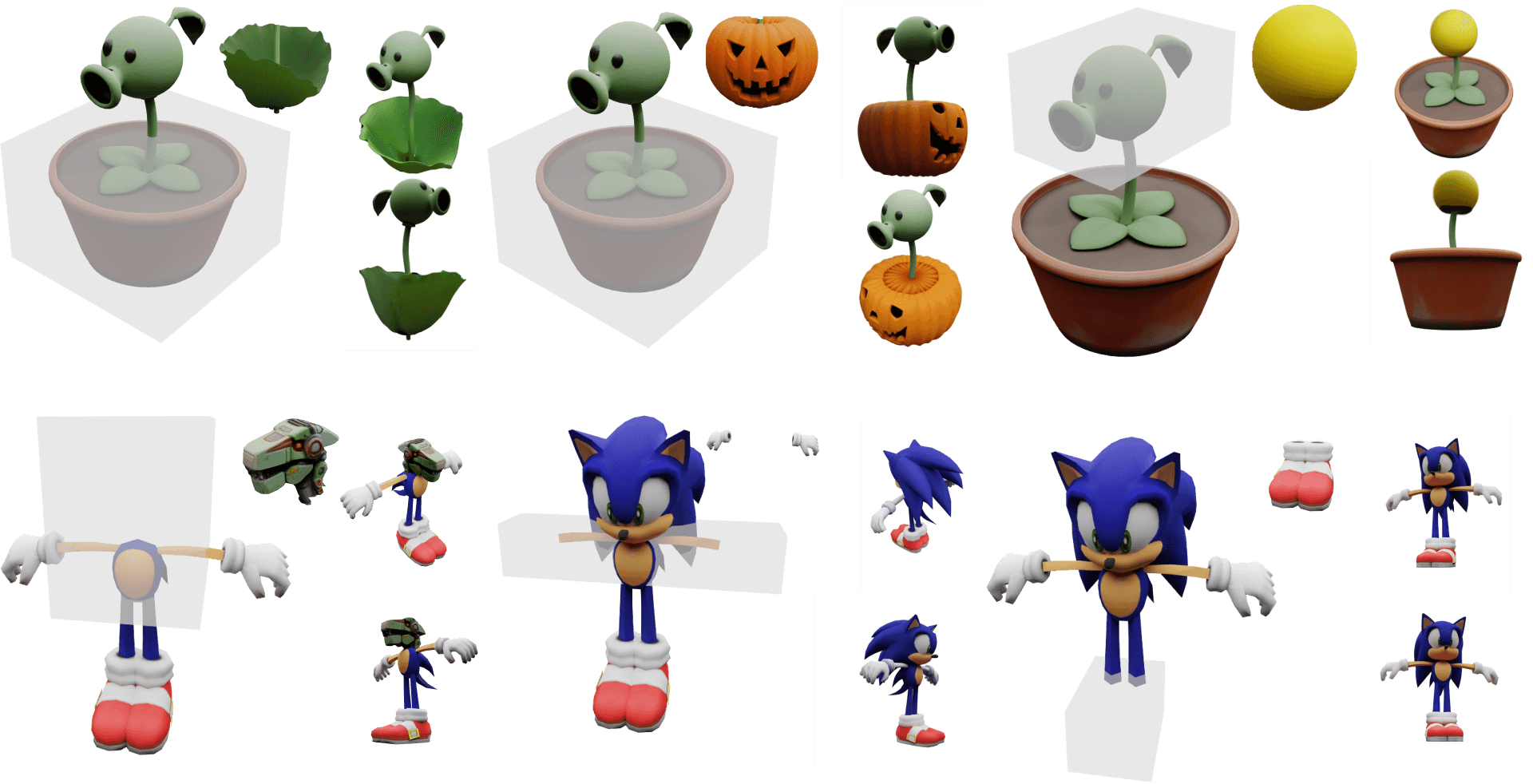
EditVerse3D teaser: qualitative editing results across diverse 3D objects

Editing results of our method. Given a 3D object, a user-specified coarse 3D bounding box indicating the target editing region, and an image prompt defining the editing goal, our approach generates high-quality, coherent edits. Our method does not require fully edited 2D views, precise 3D masks, or redundant pipelines.

Abstract

Local editing of 3D objects remains a long-standing challenge. When interacting with 3D content, humans naturally tend to specify a coarse region of interest for modification rather than defining precise editing boundaries. However, previous methods rely on fully edited 2D images, precise 3D masks, or redundant pipelines, which present a gap. To bridge this gap, we propose EditVerse3D, a novel 3D editing framework that enables high-quality object editing under such coarse guidance. Our approach takes as input a 3D object to be edited, a coarse 3D bounding box indicating the target region, and a reference 2D image describing the desired modification. It produces a coherent, high-fidelity edited 3D object. To facilitate this editing, we introduce a novel region-aware adaptive loss that emphasizes hard-to-learn regions and balances the objective between target and preserved areas. Complementing our loss function, we enhance model robustness and generalization through targeted data augmentations, such as training with scaled 3D masks and filtering out unrealistic editing pairs. We construct a large-scale 3D editing dataset derived from parts information. Extensive experiments demonstrate that EditVerse3D achieves superior visual quality and quantitative performance compared to existing 3D editing approaches.

Method Overview

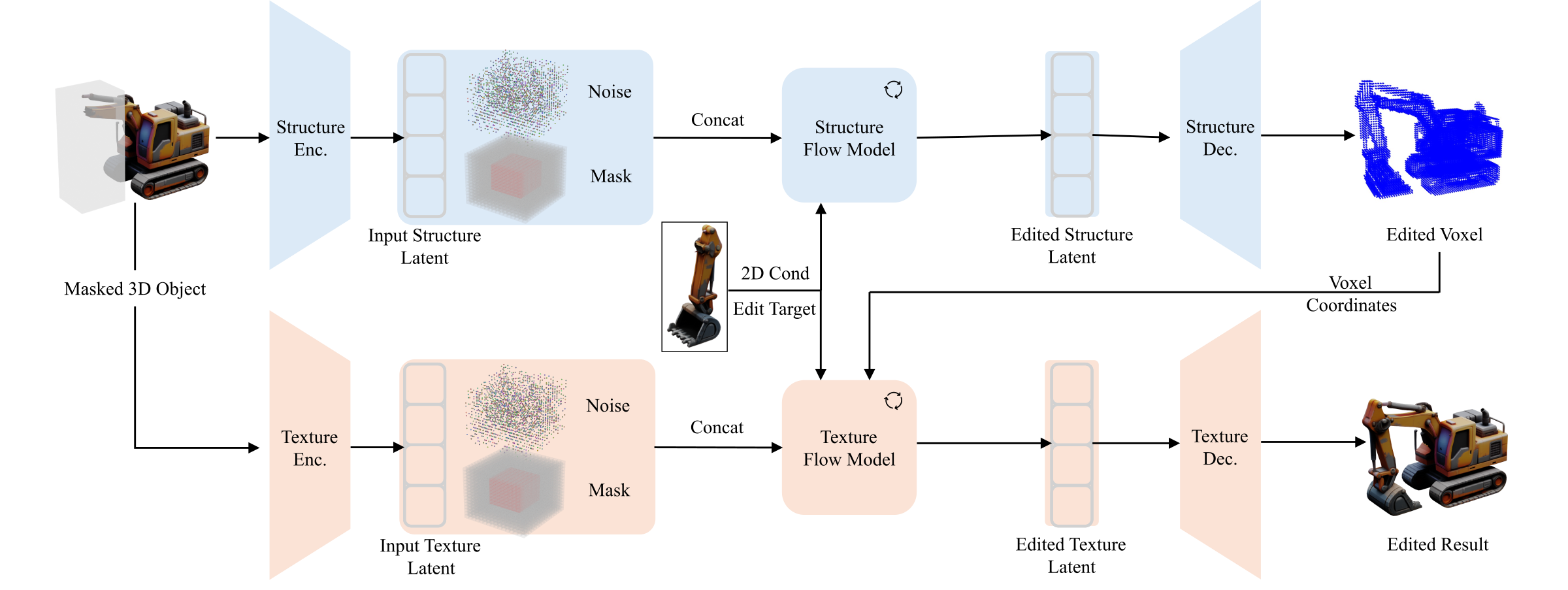
Method overview of EditVerse3D

An overview of our method. Given a masked 3D object as input, we first extract its structure and texture latents using the TRELLIS encoder. The input latents are concatenated with a binary mask and random noise along the feature channel dimension, then fed into the flow-matching model, which takes the editing target as a condition. The flow model generates edited latents, which decode into the final result.

Results

Featured: Replace edits

Image promptMasked unedited 3DEdited 3D

Featured: Add edits

Image promptMasked unedited 3DEdited 3D

More results (52 clips)

More results — Part 1 (10 clips)

Hover a clip to play; move away to pause. On touch devices, tap to toggle.

Image promptMasked unedited 3DEdited 3D
More results — Part 2 (20 clips)

Hover a clip to play; move away to pause. On touch devices, tap to toggle.

Image promptMasked unedited 3DEdited 3D
More results — Part 3 (22 clips)

Hover a clip to play; move away to pause. On touch devices, tap to toggle.

Image promptMasked unedited 3DEdited 3D

BibTeX

@article{yin2026editverse3d,
    author  = {Yin, Youtan and Zhou, Yanning and Wei, Jiacheng and Yang, Xiaofeng
               and Zhang, Jun and Bai, Jiayang and Ye, Jingwen and Zhang, Weidong
               and Lin, Guosheng},
    title   = {EditVerse3D: High-Quality 3D Object Editing with Region-Aware Learning},
    journal = {arXiv preprint},
    year    = {2026},
}